US(USD)
Decoding the Core Technology of 6-DOF Racing Simulators
- Mar.18, 2026 00:00:00
- 0 Comments
A 6-DOF racing simulator is far from being a simple "shaking game device". It is a high-tech integrated system combining mechanical engineering, electronic control and software algorithms. Its core technologies revolve around three major aspects: motion platform architecture, servo drive technology and real-time control algorithms. Every technological breakthrough determines the upper limit of realism for the simulation experience.
I. Core Carrier: Mechanical Precision of the 6-Axis Stewart Platform
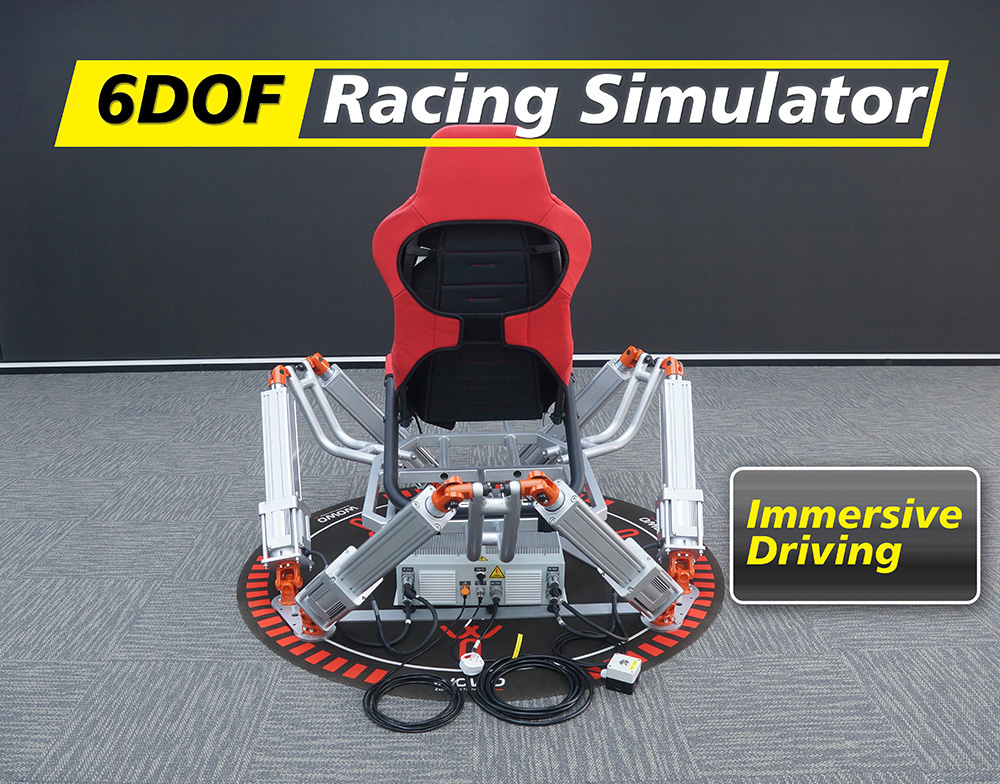
The motion core of the simulator is the 6-axis Stewart platform, a parallel structure composed of six retractable electric cylinders. It enables six degrees of freedom: translational movements along the X, Y and Z axes (forward/backward, left/right, up/down) and three rotational movements (pitch, roll and yaw).
Each electric cylinder is made of high-strength aerospace aluminum alloy with precision ball screws. Its stroke is accurately controlled within ±200 mm, with a millisecond-level response speed.
Rigid design is the key: high-quality platforms feature a static rigidity of over 5000 N/mm and can bear a load of more than 1.5 tons, ensuring no shaking or displacement deviation during high-speed simulation. The anti-slip and shock-absorbing base fixed to the ground further eliminates resonance interference, laying a solid foundation for precise motion.
II. Power Core: High-Response Servo Drive System
The electric cylinders are driven by a high-precision servo drive system, the "power heart" of the simulator. Equipped with servo motors rated at 3000 r/min and absolute encoders, the system achieves a positioning accuracy of 0.001°. Combined with current vector control, it enables stepless speed regulation and precise positioning of the electric cylinders.
When the car accelerates, the six electric cylinders extend and retract in sync to simulate a 2g acceleration pushing sensation. During sudden braking, the platform tilts forward rapidly by 15°, reproducing the real brake dive effect. In high-speed cornering, the roll angle precisely matches centrifugal force parameters, allowing the driver to intuitively feel the vehicle’s attitude.
The closed-loop control of the servo system corrects motion deviations in real time to avoid simulation distortion.
III. Soul Core: Real-Time Motion Control Algorithms
If hardware is the skeleton, algorithms are the soul of the simulator. The core algorithms fall into three categories:
Kinematics Solver Algorithm: Converts physical data from racing games (speed, acceleration, vehicle attitude) into the extension length of the six electric cylinders, with a precision of 0.01 mm.
Anti-Motion Sickness Compensation Algorithm: Optimizes motion curves to reduce dizziness caused by high-frequency shaking while preserving key sensory feedback.
Multi-Source Data Fusion Algorithm: Synchronizes with the visual system, force-feedback steering wheel and audio equipment to achieve millisecond-level coordination of motion, vision, sound and touch.
In addition, the simulator is compatible with the physics engines of various racing games, reading data in real time via API interfaces to ensure full alignment between the simulation experience and game logic.
The synergy of these three core technologies has elevated 6-DOF racing simulators from "game playing" to "immersive driving", establishing them as a benchmark for high-end simulation experiences.